
Be like water, my friend.
BRUCE LEE1

I’ve been thinking a lot lately about cycles. Like, a lot a lot. Especially spirals within cycles. How most everything in the natural world unfolds—effortlessly—in rhythmic, (largely) predictable spirals. In equal measure commanding and powerful, gentle and unhurried. Like a lazy tidal whirlpool, or the bath water laconically draining from your tub.
And how so many aspects of our increasingly unnatural world, rush forth—with enormous effort—force-fed into one-way jet-streams of dizzying speed and momentum. The careless uniformity of it all. The dangerous homogeneity it creates; even celebrates.
This world we’ve made, ever-burdened by unrealistic expectations and crushing pressure in ceaseless pursuit of biggerbetterfastermore—has taken on a life of its own. Our day-to-day tasks and long-term goals are railroaded into an artificially linear flowchart of false choices and mock freedoms.
And we, the Citizens of Earth, like so many cattle blindly funneled in the frenzy, off to slaughter. Because surely this is no way to live.
A bit dramatic? Perhaps. But it all feels to me so very, very wrong. So disconnected from the truth of things. So counterproductive and exhausting. And I’ve been wondering. Musing. Wading through the currents of my own life to make sense of it all… how have I, like a salmon swimming upstream against these impossible forces, been shaped by all of this unnatural efforting?2
In what ways has this reckless push-and-pull dynamic forced my thoughts, over time, into dysfunctional patterns? How has this toxic disregard for the natural ebbs and flows of life poisoned the well-spring of my constantly bubbling internal narrative? How have my subsequent behaviors and choices been dammed-in and corralled? And how has—does—all of this limit what’s possible for the rest of my lifetime in this body, on this Earth?
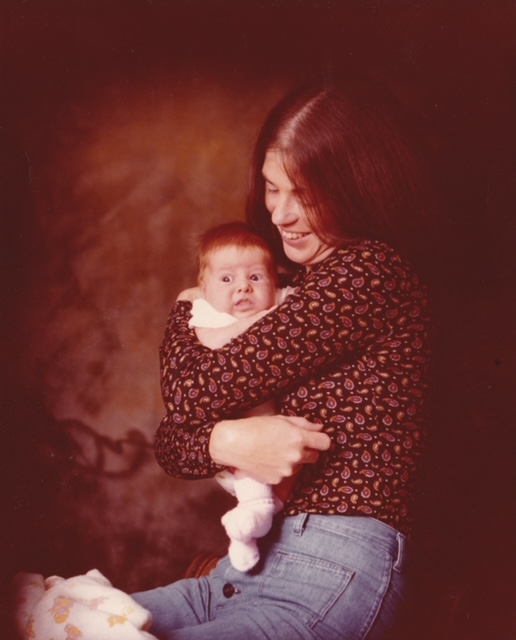
(Me, evidently born terrified of the impending stress of it all!)
Until pretty recently I viewed, experienced, measured, and judged (harshly, I might add) my own growth and development through a very linear lens. I grew up with values that centered on the importance of constant improvement, the quest to excel, the importance of consistency, the all-holy and indomitable “strong work ethic.”
While none of these concepts is bad or wrong in and of themselves, in the absence of their complementary counterpoints they can (and certainly did for me) create unhealthy paradigms.
For example, if I expect myself to constantly improve but allow no space, grace, and even embrace for its opposite—the periods of plateau, the moments of backslide, the inevitable failures (particularly without the insight that failures are opportunities for learning; a view I never grasped in my youth)—I hold myself to an unrealistic standard. I construct an impossible challenge. It’s a game I can never win. Which is tricky, because winning is paramount in this linear value-based world.
We are all in trouble when these kinds of values become blind expectations without balanced perspective on why their opposite is also valuable. And while we’re at it, many of the gray areas in between. Life isn’t just a sequence of binaries.
Take fitness. I can’t run 10 miles (or even 2 miles) every day and expect to become continuously healthier and fitter, moving ever-onward and ever-upward in pursuit of some ideal, if I don’t also take regular rest days and alternate with varied forms of exercise.3 My body requires this process of calibration.
When I fail to strive for balance, my exercise routine becomes unhealthy, creating a ripple effect of injury or other systemic imbalance. Maybe it even triggers additional behavior dysfunctions, addictions, emotional dysregulation and so on. I have been there more times than I care to admit.
But when I honor that balance and approach exercise habits as a cycle, with adequately grace-filled consistency, my commitment does result in progress toward whatever my fitness goals may be. Plus I make the most of my efforts and more fully harness the benefits of exercise.
Cycles are all about bringing things back into balance.
And yet… that’s not the full picture of a cycle. You may find, like me, that there are also cycles within a cycle. Sometimes there might be a spiral in there too. For example, I’ll get into my running routine for some number of months and really on a tear, feeling great… then inevitably something crops up to push me off the wagon. An injury (damn shin splints) or the season changes (running in the winter makes me cough something terrible) or just plain old busyness. And I might not run, or exercise much at all, for a couple of months.
So, am I back to square one? Have I dropped the ball on my fitness goals? Definitely YES, if I view this pattern through a strictly linear lens, and judge it as a failure of commitment. On the other hand, when viewed through a cyclical lens, this pattern looks more like a healthy adaptation to the natural rhythms and challenges of life.
From a linear perspective, my fitness goals are something to be conquered and my body is a static “thing” I seek to control. Ew.
From a cyclical perspective, my physical fitness is a dynamic state of being in which the true measure of my health isn’t the way my body looks or my BMI or how long I can stay in downward dog (not long, turns out)—but the degree to which I prioritize physical activity while being both sensitive and responsive to the changing needs and circumstances of my life. And not just my physical life, but my emotional, mental, spiritual life too.
So… if perception is reality, which version of reality do I want to live in? (And since we’re asking, can I pick the one where running for fitness looks like this?)
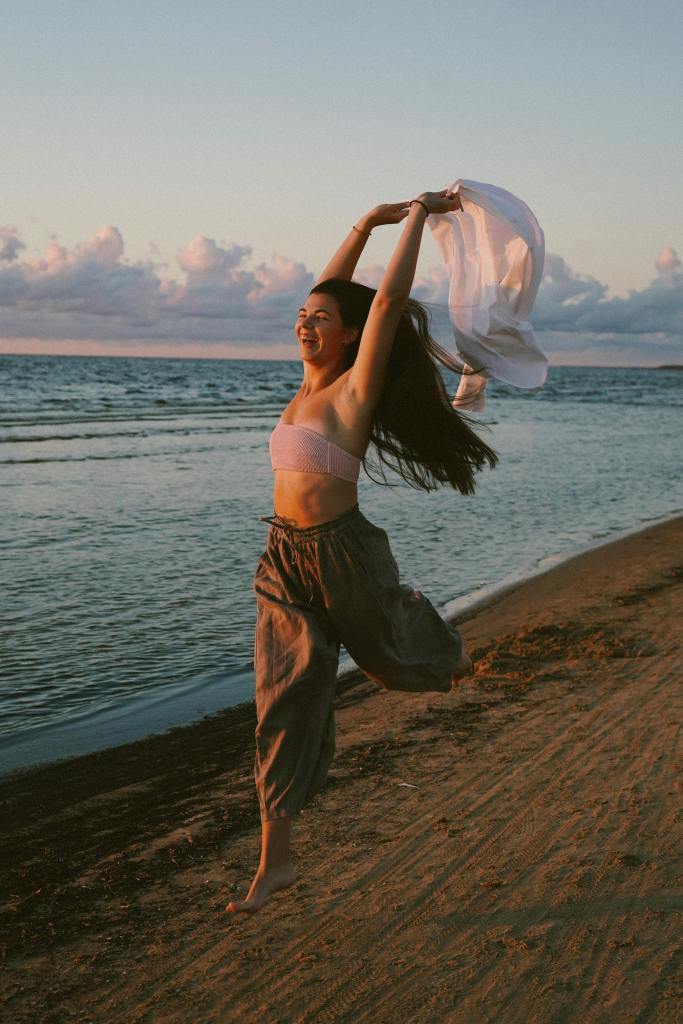
But look: I may be impatient to get to my goals. (I consistently am.) I may imagine that powering through in a more linear “all in” approach will get me there faster. (I do, with maddening regularity.) And it may sometimes work out that way for a little while.
But in the long run—and hell, for me, even in the short run (pun intended)—the negative consequences of unnatural pushing and efforting always set me back further on my imaginary straight line of progress. By now I’m hip to the pitfalls and persistent predictability of that cycle, and I’m not having it.
Now let’s look more closely at spirals.
Say I find myself in a pickle, faced with a dilemma that feels familiar—say I’ve overreacted and said something I regret in a moment when my buttons were pushed. After reflecting, I feel exasperated: “Gah, why did I say that? I’ve been here before! Why haven’t I learned this lesson yet?”
But in truth, I haven’t been here before. Not exactly. I may have been in a similar situation with similar circumstances and challenges, but I’ve never been here before as the person I am right now.
The impulse to gage our previous successes and failures against our current iteration of self isn’t really asking the right question at all. A better question might be, “What is the Universe trying to teach me by throwing out this challenge right now?” Or, “How is this version of me better positioned to handle this situation than the old me?”
It all happens in cycles and spirals. The circumstances come back around, and sometimes they look and feel frustratingly similar… but it’s all different because you’re different. If you’re doing the work of developing yourself as a human, chances are you’re on a higher plane of the spiral and therefore able to meet the challenge as a more elevated, capable version of yourself.
But when our thoughts and actions are driven by linear (non-cyclical) values, they cease to be useful as guiding principles for life. Instead they become dangerous dogma for our inner critic to shout on repeat all day over the loud speaker reverberating inside our weary skulls. They wear us down instead of raising us up.

Perhaps a more timely and personal case-in-point is the writing of this very blog. From the second I decided to begin it—long before I’d ever crafted a single word or gone down the rabbit hole of how to even make a blog site in the first place (raise your hand if you were born pre-1980 and have strong misgivings about social media, oh and also generally dislike technology!)—the diligently trained soldier of my mind was already setting unrealistic goals for how much I would write, how often I would post, how productive it would all make me feel: this future achievement.
Even though I wasn’t consciously approaching it as something to “accomplish,” my output-oriented brain was still real-time logging it as a to-do list just itching for check-boxes. Even though I actively experienced the intuition to begin writing as a creative act, an artistic release, a deeply pleasurable pursuit—this brain software running like never-ending ticker-tape in the background of my awareness was doing its thing on autopilot.
So why, you might ask, is this a problem? Isn’t it helpful to have a plan? A goal? To be organized? And sure! You wouldn’t be wrong. These things might have their place as a *part* of a process. But for me (and I suspect I’m not alone) when they run the show on a subconscious level, they undermine my pursuit before I even take the smallest action step toward my idea.
By superimposing a linear mindset on a cyclical impulse, these subconscious programs set expectations of production and uniformity… where once had been an impulse toward the sheer joy of creation. This is when the magic in me dies before it even begins to grow.
They erode the purity and potency of my creation with caustic timelines, word counts, and big-picture writing goals. They create unnatural boundaries and borders that limit my expression. They curb my sense of possibility with judgements and negativity and oh-so-many made-up rules. And ultimately they dampen the innate brilliance4 of my artistic instinct altogether, suppressing the free-flow of my wild river of potential.
If I continue down this linear, output-based path without examination, before I know it the devil-on-my-shoulder starts to whisper. What people will think of my writing? What will people think of what I write? Will anyone ever read it in the first place? Will I actually do what I set out to do, or get distracted and move on to something else? Is this is all just a silly idea? Why am I not focusing on something more practical? Will any of this even make a difference in the grand scheme of things? Blah, blah, blah…
And before I’ve even written a word, I’m already wrapping the vibrant threads of myself right back up into that tiny, tightly wound ball.
But if I allow myself the space and grace to let the process unfold naturally. Cyclically. Spirally. If I just let it be what it longs to be. I create space for the growth and expression I’m craving. The real reason I’m driven to write in the first place. To free up the fresh water flowing underneath all of those heaps of rubble and layers of mud and monstrous boulders. The space that’s needed to become more myself.

So when I felt this pressure from within at the nascent stages of my creative process, I paid attention. In fact, I kept an eye on it with something verging on vigilance. Because it felt critical for me to do things differently this time. To wade across the river against the powerful counter-current to which I’ve usually succumbed, and find out what was on the other side.
And so, when I had written the first few posts and flushed the initial surge of backed-up storm-swell out of my system, and I felt the instinct to pause and reflect and turn my energy elsewhere for a bit… And when my head began to buzz from the hounding inner voice to Stay on schedule! Get into a routine! Write another post before you lose your momentum! …And when I felt the weight of self-judgment and expectation heavy on my chest… I simply observed it, and did nothing.
(Well, not nothing of course. I did a thousand other things, but I did not write! Sidebar: see my Prologue for a serious déjà vu.)
I willed myself instead to sit with the deep discomfort of my urge to DO, and allowed myself to BE. I waited sort-of-patiently for nearly three weeks until I felt the authentic impulse to create again. I made sure the impulse was driven not by obligation, but rather sparked by inspiration and joy. And then I sat myself down again to write.
See, for me, the creative process must exist as a cycle, as a spiral, or not at all. The inspiration comes and goes, and this is not just “okay” but necessary and vital. If I try to curtail it or force it into an unnatural rhythm, I deny myself the experience of organic percolation—the dripdripdrip of fresh rainwater fortifying itself with rich ideas and ancient wisdom as it wends its way back to the underground mother-stream—to inform what I’m intended to create; to shape what I’m meant to share.
If I rush it, I dilute and dishonor it. If I write or otherwise create from the pressure of someone else’s voice or insistence—in a linear, time-bound, output-centric approach—the creation will not be my own. Nor will I have been nourished by my creative process. I will be depleted by the effort of swimming upstream, as I always have.5
So. It will emerge when and how it will. And while my ideas may seek to enter the material realm with a sense of urgency and import (to me), they are every bit as temporal and fleeting as anything else. Captured on the digital page for a moment in time, each letter a grain of sand destined to be washed back out to the universal sea of ideas.
I will endeavor then to be no more, or less, than a vessel for their emergence. With curiosity and love. Without judgement or agenda. Free from wo/man-made deadlines. Beholden only to the ever-spiral that is this life.
Keep wilding with me! Subscribe to the blog below👇🏻
- And also, as a whirlpool spinoff to this liquid wo/andering: a beautiful pondering by Maria Popova on the philosophy and origin of Bruce Lee’s famous quote. ↩︎
- I understand this word is poorly accepted by many, but I can’t help myself and I won’t apologize. I love it. ↩︎
- Okay, some people can do this but I can’t. Those shin splints will come for me every time. ↩︎
- A word that here refers to an essence of brightness, not intellectual genius. Though you can be the judge 😉 ↩︎
- All of this musing sheds a great deal of hindsight-ful context on aspects of how I struggled as an actress in my 20’s. I wasn’t able to strike a balance when I tried to position my art as a livelihood. The paradox of creativity-for-pay was anathema to my inner compass. ↩︎
- Photograph courtesy of the lovely Rachel Darden Bennett, who is a true friend and artist and all-around humanitarian. ↩︎
 Till My River Runs Wild