“Growth is painful. Change is painful. But nothing is as painful as staying stuck somewhere you don’t belong.”
MANDY HALE
In my last post I set the stage (er, dance floor) for how I unconsciously shimmy-drifted further and further away from the dreams of my youth. How, as I navigated through adolescence and into early adulthood, I gradually lost touch with the sense of wonder and self-knowledge and possibility innate to me as a little girl.
Truth is, I lost myself altogether.
What happened next? (Readers Digest ultra-condensed version.) I got married, segued away from performing, had a baby, moved out of NYC, had two more babies, and parlayed my two-week temp job into a 13-year stint in public education reform. Working from a home office in the suburbs of Eastern Pennsylvania. A million miles away from the life I had loosely imagined for myself—but with every externally observable proof-point that I was “living the dream.”
And here’s the thing.
For those 13 years, I mostly hated my job, most of the time—even as I felt guilty for feeling this way because I “should” feel grateful and fulfilled. There wasn’t anything wrong with my job or the company, but it was wrong for me.
And I mostly felt that I wasn’t where I was supposed to be, most of the time—even when I wasn’t working my job that I hated. There wasn’t anything wrong with where I was (in fact there were many objectively wonderful things!), but it still felt wrong for me.
And I mostly felt that I was failing, most of the time—even when outward measures of success strongly indicated otherwise. There wasn’t anything wrong with my competence or achievements, but I never felt like I was good enough (both intrinsically as a person, and in terms of the things I did) and was plagued by a nagging sense that I was focusing on the wrong things.
And I mostly felt that I wasn’t really living my life, most of the time—even though I had zero frame of reference for what would be different, or how I would even know, if I were really living my life. There wasn’t anything wrong with my life, per se—by a hundred different metrics, I had an extraordinary life! By all measures, I daresay, except my own. My own life felt deeply, irrevocably wrong for me.
And the more I felt this way, the more I doubled down on my work. And the more I doubled down on my work, the more I felt this way. And the more tightly I chained myself to this destructive cycle, the less and less attention I paid to my desperate, tiny inner voice. And the less attention I paid to my inner voice, the more time I spent unconsciously crafting and fine-tuning the story I was telling myself on repeat, silently, every day, inside of my own head.
The story of all the things that were no longer possible for me. The story of all the circumstances I needed to accept and the ideas I had to give up on. The story of how I needed to be prepared to face things in this way for the rest of my life. The story of how this is just “what people do.” More specifically: “this must just be what it’s like for women, and why should I be any different?”
Now this wasn’t just about my job or my career ambitions, or even my sense of purpose. The arc of this “what I want to be when I grow up” story is a useful frame for the angsty still life I’d been painting, but my Sturm und Drang was about so much more than that.
This was about my sense of self-worth and value. This was about a lifetime of abuses of my body. This was about my unhealthy relationship with alcohol. This was about my unraveling marriage. This was about my entire identity.
Thankfully, there were always beautiful elements of my painting that felt like lifelines to my true self. Elegant brushstrokes highlighting those things that were perfect just as they were. My precious, magical, madness-making children. A tiny handful of authentic friendships. The unconditional love and support of my family of origin. Ever-growing awareness of the place of incredible privilege from which I experienced (and continue to process) all that I share here.
Yet this curdling mess brewing inside of me, it encompassed so many aspects of my life. I didn’t see or feel any way out of the corner I’d painted myself into. I couldn’t even see the corner or the paint. I KNEW on some deep level that it was all wrong because of the ripple effect of negative emotions that bathed my nervous system. My feelings were the symptoms, and my subsequent behaviors were the cries for help. But my denial was absolute, and I was absolutely unconscious to it.
The more time I spent in this space, the more I judged, resented, resisted, pretended, forced, numbed, ignored, rationalized, manipulated, controlled, and otherwise wasted the precious moments of my life. The more I did those things, the harder I worked to play the role of a person who had it aaaaall together. And I put on a pretty convincing show.
I could be everything for all people. I could do anything for anyone. (Except work remote controls. I never pretended to be good at that.) I could power through the toughest scenario without breaking a sweat. I could shoulder the most difficult emotional burden with nary a tear.
I could do all of these things; or at least I tried my damndest to appear so. I’m sure there were plenty who saw chinks in my Academy Award-winning armor, but they’ll appreciate that even the best performance has flaws.
I needed to keep all the balls in the air (while spinning all the plates) 24 hours a day, because a big part of me firmly believed—and if I’m honest, a teensy-weensy part of me sometimes still does—if I let go of any of it, even for a moment, my entire life would come crashing down around me.
Oh, and while I did all of those things—because I was painfully aware of the stereotype of a woman who behaves in the exact way I was behaving, and desperate to remain free of those perceptions—I also worked very hard to counteract the impression that I was “that woman,” and so became a double-agent to my first false identity.
(You know, Method Acting. This extended-run pièce de résistance is where all of my college tuition money really paid off. Definitely some of my finest work.)
I invested unfathomable energy into the herculean task of keeping up this facade. My unconsciously orchestrated charade was intended to fool others into thinking I was someone I’m not. But at a deeper level it was more subtly designed to prevent them from knowing who I really was.
Because I didn’t know who I really was. And I was terrified that if I ever took a real honest look, I would discover that I was “too much” AND/OR “not enough.” Since neither of these scenarios were possibilities I wanted to face, I simply settled on knowing that the not knowing was scary as hell. And I wasn’t ready to walk through those flames.
None of these behaviors or beliefs were the slightest bit conscious for me at the time. But it all played out this way as I squirmed in my own skin through each day, desperate to escape the truth of what my life had become. The truth of how I felt about it. The truth of how I felt about myself. The truth of the impossibly vast chasm between what was and what could be.
And so, in this way and along the way, I completely lost touch with those dreams of my childhood. Equally tragic, I lost touch with the sense of possibility that accompanied them. The very real, felt experience of Knowing that all manner of extraordinary things were distinct and reasonable potentials for me. And the visceral thrill of that knowledge. Gone.
Sensing back in time, I think it all started to fade somewhere around age 12 or 13. (The age of my oldest child at this very moment. A fact not lost on me.) Something in me started to harden and stiffen. I grew more self-protected, like a shell was creeping up around my heart. I felt colder, tighter; less pliable, less imaginative. I was increasingly disconnected from my Source. So my hopes and dreams no longer felt possible.
Sure, I made attempts to appear as though I were pursuing dreams. Some of it probably looked ambitious to others. Even grandiose! But for me, on the inside, none of it ever seemed possible. Not really. In an ironic life-mirroring-art-mirroring-life sort of a way, I always felt like an actress playing at the game of life, not a real person living it. And dreams in general were no more than fairy tales for children.
I remained fragmented from my soul and from my dreams with few exceptions—rare moments of synchronicity, flashes of intuition that managed to get through the static, glimmers of hope (almostbutnotquite joy) that offered a fleeting taste of what could be/should be/would be—for the better part of the next 30 years.
Exactly four years, five months, and 15 days ago I took my first sincere step toward beginning to believe again in my dreams. I had exhausted all of my body’s natural reserves, burned the very last drop of midnight oil, and sputtered to a sick-and-tired standstill when even the fumes couldn’t sustain me for another day.
My beautiful, miraculous, deeply wise physical body thrust me into crisis and sounded the alarm. Wake up!! she insisted. Wake up to yourself and to your dreams again. NOW, or else… (the ominous deeper meaning was crystal clear as a mountain stream)… it won’t be long before you never wake up again.
—With full awareness of how overly dramatic and hyper-serious this all may sound, I Knew she meant it literally.—
So this time, I listened. I listened to the desperate, tiny inner voice. She said, “Be still, and know.” And I began to practice.2 I began the arduous journey of rediscovering my dreams. Of rediscovering even how to dream, as I had forgotten altogether. From this place—(I might call it my “rock bottom” but I won’t, as that was still to come)—I took a leap of faith. I tried something new, because all of the old things weren’t working.
And now I see that what I did on this day was not in fact anything new. It was something quite old. As old as me, actually. It was my original, natural way of being. The way of being I had forgotten completely. The way of being I had buried so deep and inaccessibly that it felt more like a memory from a story I read once about someone else’s life. The memory I had stowed away so watertight that it had no hope of ever flowing free into the wild river of my true self.
Now I practice dreaming dreams that encompass all aspects of me and what it means to be alive in this body on this planet at this moment in time. And while some of my dreams today do harken back to my childhood, relating to what I want to “be” or do for a livelihood—joyfully, many of them are much richer and more expansive than that.
(Also, for the record, I still don’t know what I want to be when I grow up.)
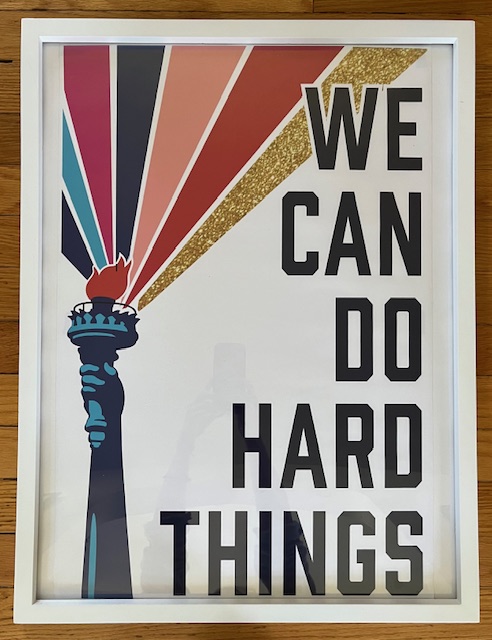
I have since learned that such dreaming occurs effortlessly for many people, which I find perplexing. For me it’s very hard work. Or at least it was for a long, long time. As I practice, it is getting easier. And as it gets easier, I grow more ease-ful. On the whole, anyway. I’m still a fairly high-strung person, but I like to say I’m “in recovery” for that!
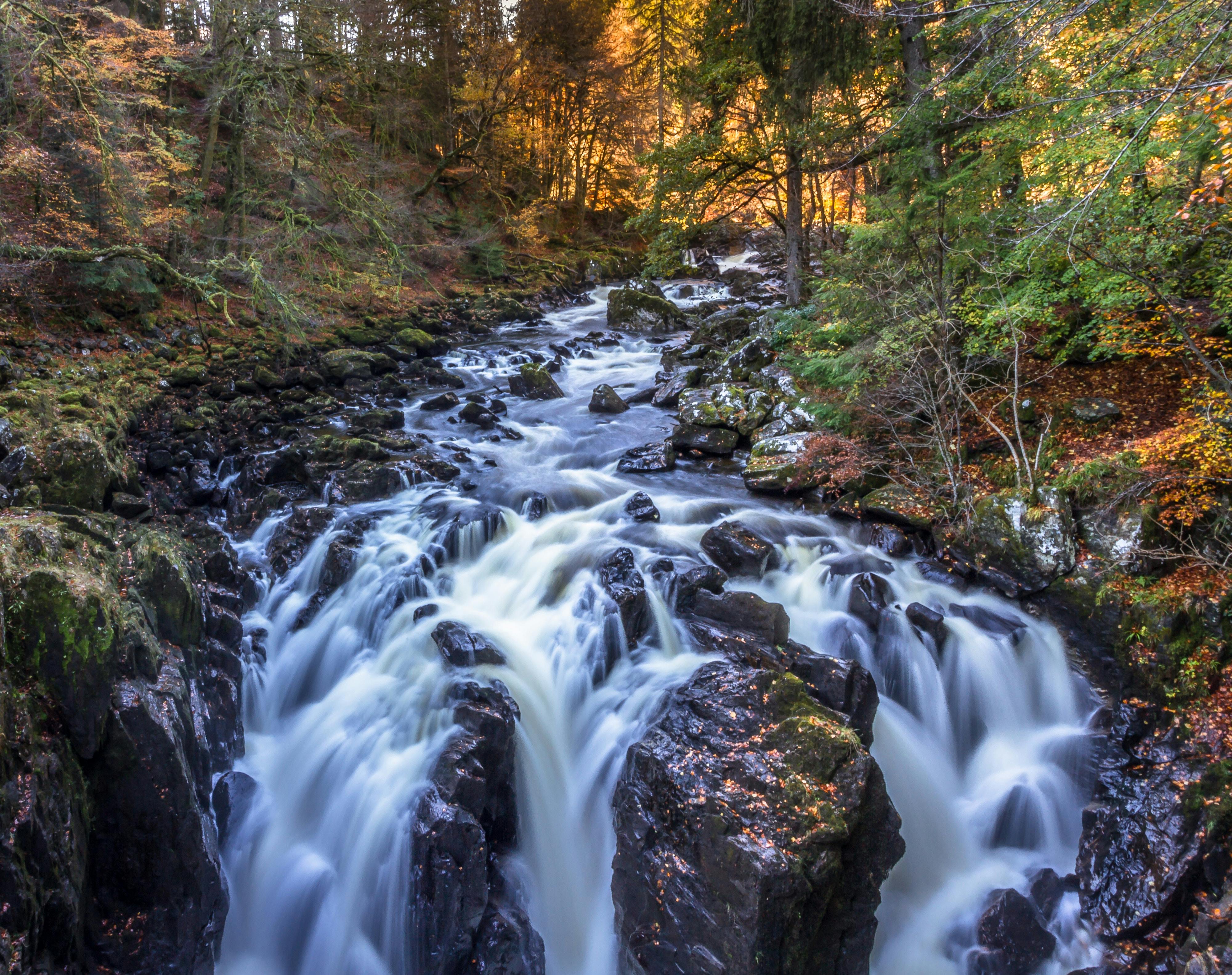
To me, this is sacred work. A devotion of sorts, to myself. A promise to identify and liberate each and every dream that swirls in the subterranean eddies of my magical rushing river. Till one day, again, my wild river runneth over, so full to the brim with dreams that it can no longer be contained by any meandering, earthen track.
Keep wilding with me! Subscribe to the blog HERE👇🏻
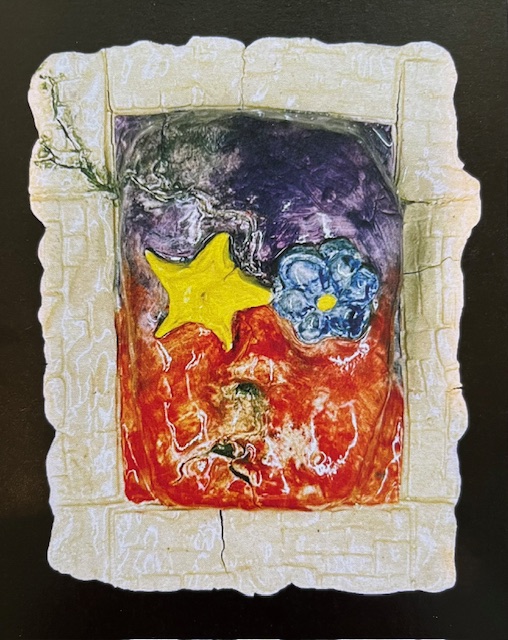
- The mask I made with the I’m fine project. Initiated in 2019 by co-curators Carrie Breschi and my cousin, Maureen Joyce, I’m fine. is a series of workshops where participants create ceramic masks that represent the outward “mask” each wears to portray, hide or minimize their emotions and mental health challenges. I can’t say enough wonderful things about this fabulous project! Check it out! ↩︎
- For me, the practice was meditation. It truly saved me. More on this topic for sure down the line. ↩︎
- Like someday maybe learning how to take a photograph of a reflective surface without my own reflection in it. But more importantly: an homage to Glennon Doyle, one of the most inspirational women out there. ↩︎
 Till My River Runs Wild